
Liquidity pools, TVL and 24h volume
Before confirming a swap, it pays to glance at the pool behind the numbers.
The two key signals — TVL (Total Value Locked) and 24h trading volume — tell you how deep and how active a pool is. Together, they predict how steady your swap will be and how much price impact you’ll cause. Understanding them turns guessing into awareness.
Important to know
- Liquidity pool: a smart-contract vault holding two tokens (jettons). Automated market makers (AMMs) use these pools to quote prices and process swaps.
- TVL (Total Value Locked): the total amount of assets stored in a pool or protocol, usually shown in USD equivalents. For swaps, focus on the pool that matches your token pair.
- 24-hour volume: the total value swapped through a pool during the past day. It reflects activity, not size.
- Price impact: how much your swap changes the pool’s price curve.
- Slippage tolerance: how much deviation you allow between quoted and executed price before a swap cancels automatically.
How liquidity pools work on TON
Each liquidity pool on TON is a smart contract holding two jettons in balance — for example, TON ↔ USDt. As users swap one token for the other, the contract automatically adjusts the price. Bigger pools absorb more volume with less movement, smaller pools shift prices faster. Every swap interacts directly with the underlying smart contract — no intermediaries, no order books.
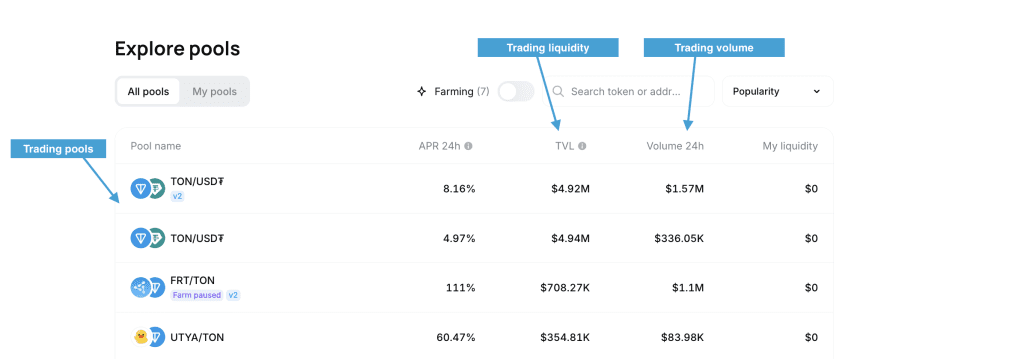
TVL and 24-hour volume: depth and activity
TVL is the pool’s depth gauge. High TVL means the pool can handle large swaps with minimal price change. Low TVL means the same swap will move the curve more.
For swaps, ignore protocol-wide TVL — check the specific pair you’re using.
24-hour volume is the activity gauge. It answers: Has this pair been trading today?
Steady volume suggests ongoing arbitrage and refreshed prices. Thin volume hints that the pool may be stale or easily moved.
Together, they define pool quality:
- Deep + active → smooth execution
- Deep + quiet → predictable but slower to rebalance
- Shallow + busy → volatile, higher slippage risk
Reading pools on STON.fi
Pick a pair, for instance TON → USDt, and look past the headline quote. The most useful lines on the screen are these:
- Price impact (value difference). Shows how much your swap bends the pool price. If the number looks heavy, the pool is shallow for your size.
- Minimum received. Your safety net: the contract guarantees at least this amount or reverts the swap. If this figure is far below the quote, your slippage setting may be too loose.
- Route. Sometimes the best price is not a straight line (A→B) but A→C→B through deeper pools. If the route looks odd or includes a very illiquid token, reduce size or reconsider. STON.fi’s Omniston liquidity aggregator handles the work and finds the best possible route.
A practical rule: if price impact exceeds 0.1–0.6 % on a major pair, either reduce size or wait for calmer liquidity.
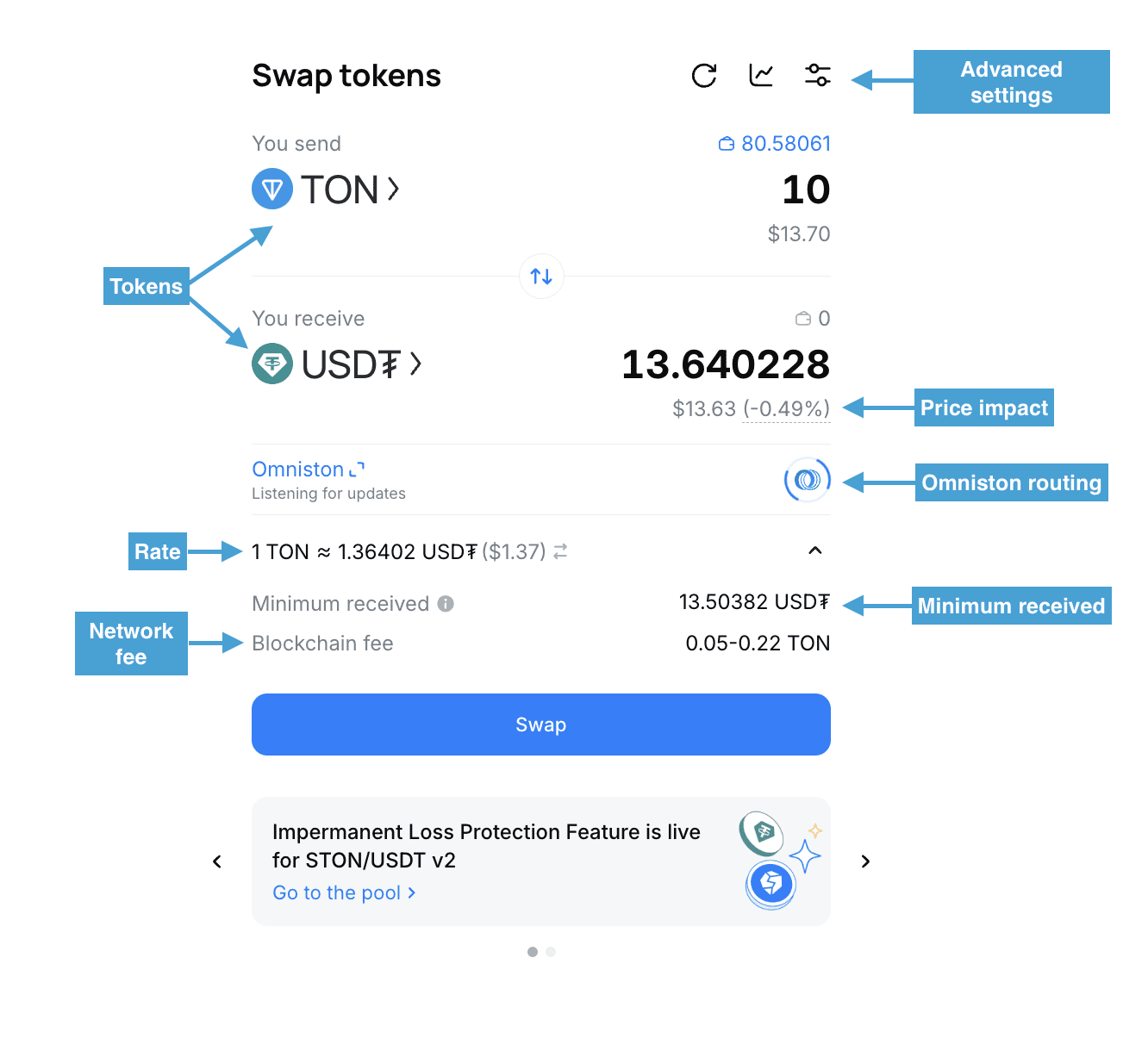
You send 10 TON.
You receive 13.64 USDt. The -0.49% indicates a current value difference (price impact).
Omniston is active (“Listening for updates”) — the liquidity aggregator finding the best route.
What price impact and slippage really show
A pool always keeps both tokens in balance. Suppose a pool holds 1 million TON and an equivalent value in USDt, and you swap 10 000 TON — about 1% of its size.
The algorithm shifts the exchange rate slightly to maintain equilibrium. That small shift is price impact — the cost of using available liquidity.
Slippage measures the difference between the quote you saw and the final execution price. It happens because the market may move before your transaction confirms.
- Tight slippage (0.01–0.5 %) protects you but may cause failure if the price twitches.
- Loose slippage (0.5–1 %) increases tolerance but can lead to worse rates during volatile moments.
Real-world examples
A. Deep and active
High TVL, steady volume. Price impact reads 0.05 %. You can set tight slippage and expect the quoted rate.
B. Shallow and active
Low TVL but sudden news spike. Price impact shows 1.8 %. Downsize or route through a stablecoin pool instead.
C. Deep but quiet
Solid TVL, low volume. Impact shows 0.5 %. Splitting the order gives the pool time to refresh via arbitrage.
Swap tokens more effectively
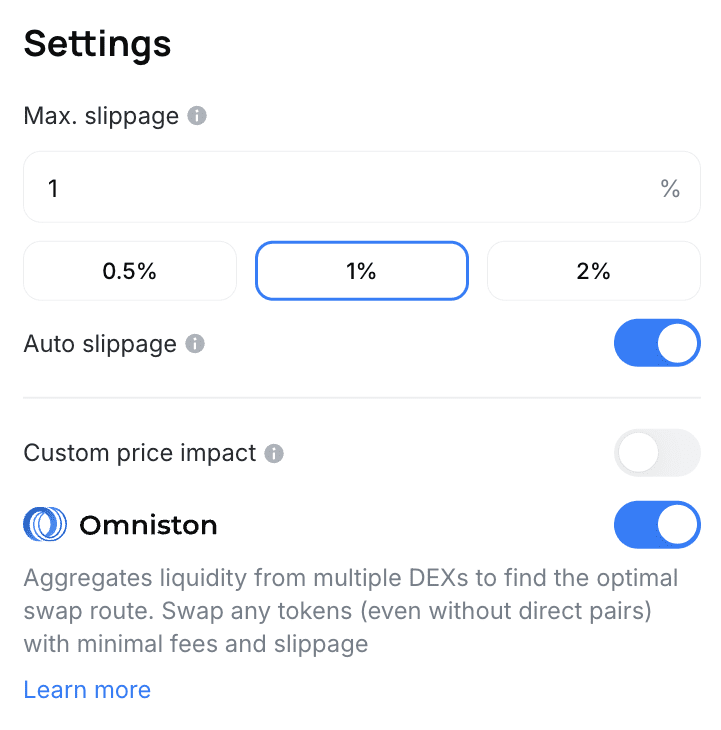
The workflow stays simple: choose a token pair → set a maximum slippage tolerance (especially important for larger trades) → review the price impact, minimum received, and route → confirm in your wallet.
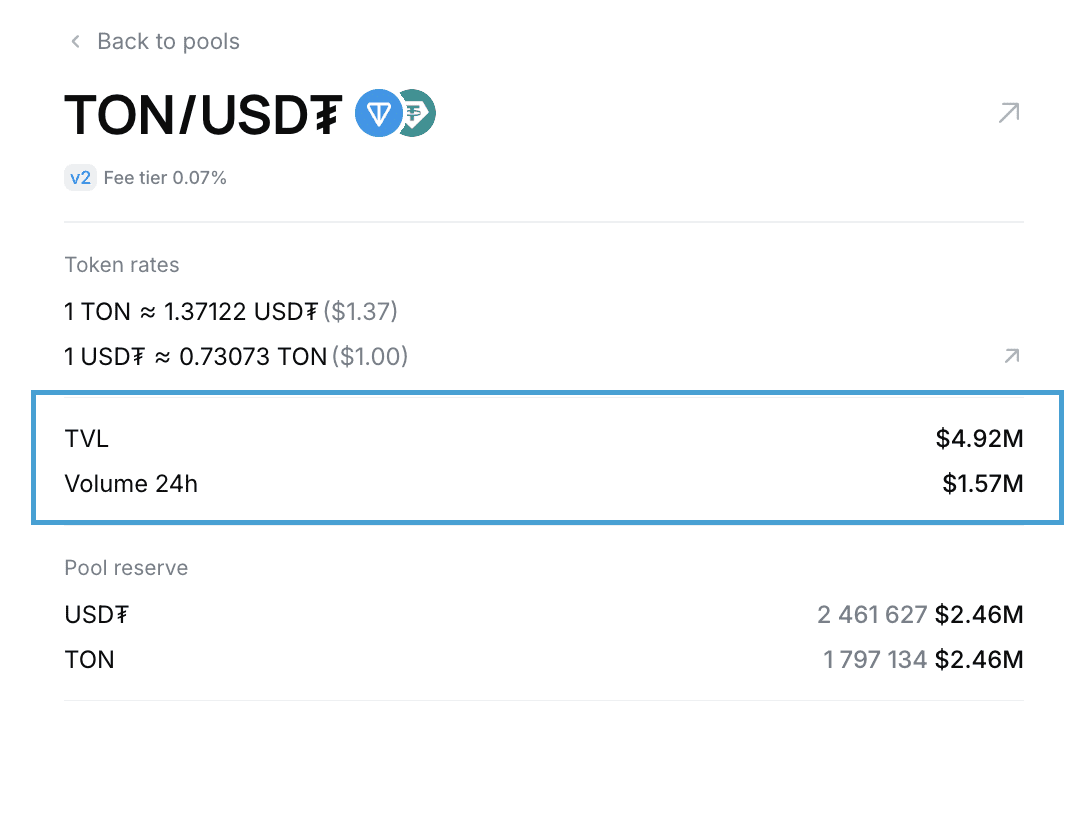
Before pressing Swap, go to Pools, select the pool you’re interested in and check its TVL and 24-hour volume — these two numbers describe your real trading environment better than anything else on the page.
Quick pre-swap routine
- Check the pair’s TVL and 24 h volume.
- Read Price Impact and Minimum Received.
- If impact > 1 % on a major pair, split or wait.
- Keep a small TON balance for network fees.
Conclusion
Token swapping on TON is a powerful feature that enhances the network’s utility and fosters a dynamic DeFi ecosystem. By understanding liquidity pools, TVL, and trading volumes, users can make informed decisions and participate effectively in this growing market. As TON continues to evolve, we can expect further innovations in decentralized trading and liquidity provision.
Additional sources
- DeFiLlama – comparing liquidity depth and activity trends across ecosystems.
- GeckoTerminal – real-time charts for TON pools
- Tonstat – TON-native analytics
- Tonscan – pool- and jetton-level on-chain data
- CoinMarketCap / CoinGecko – aggregated liquidity and 24h volume across exchanges and chains

Valuable Insights
- TVL = depth; volume = activity. Together they define pool quality.
- Deep + active pools give the most predictable swaps.
- Price impact above 1% on a major pair is a warning.
- Minimum received protects your outcome — always read it.
- Slippage should match market mood, not habit.